
The Power of Organizational Consulting for Business Growth
12 April 2024TAB Business Diagnostic — Case Study: From Two Greens to Six | NIRMAKO
11 August 2026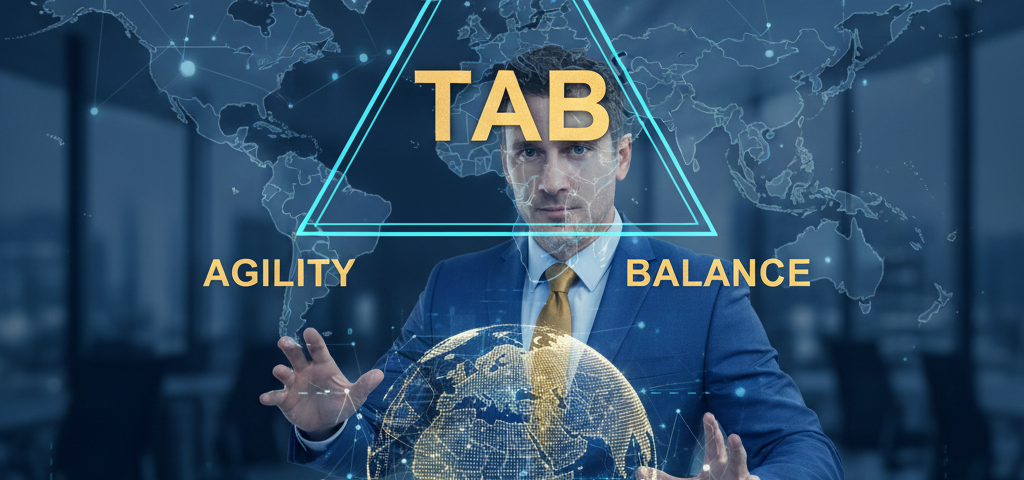
In an era where geopolitics affects every aspect of business management, technological leadership requires a fundamental shift. The question is no longer whether external forces will impact your business—they already do. The real question is: how prepared are you to respond?
As a business coach working with Israeli technology leaders, I’ve witnessed firsthand how companies either thrive or collapse based on their ability to adapt. The difference? A strategic framework I call TAB: Talent, Agility, Balance. This isn’t theoretical fluff—it’s a battle-tested approach that separates market leaders from those left behind.
Recent reports from KPMG and Deloitte confirm what we’re seeing on the ground: businesses must adapt to geopolitical risks to remain competitive. Cyber threats escalate daily. US-China tensions reshape supply chains. The war in Ukraine continues to send shockwaves through global markets. In this environment, the TAB business framework isn’t optional—it’s survival.
Talent: Your Most Strategic Asset in Uncertain Times
Let me be direct: your technology stack means nothing without the right people operating it. In a geopolitically volatile market, talent becomes your primary competitive advantage. But here’s where most companies fail—they think recruitment solves the problem. It doesn’t.
True talent strategy goes far beyond hiring. It requires a systematic approach to identification, development, and retention. I recently worked with a mid-sized cybersecurity firm in Tel Aviv that understood this principle. Instead of competing with Google and Microsoft for senior engineers—a battle they couldn’t win—they invested heavily in training their existing workforce in AI and advanced threat detection.
The result? Within eighteen months, they developed proprietary solutions that larger competitors couldn’t match. Their response time to emerging threats dropped by 60%. Revenue increased by 40%. They didn’t just survive the talent war—they redefined the battlefield.
Here’s what effective talent management looks like in practice:
- Continuous learning infrastructure: Allocate budget for ongoing education, not just onboarding. The technology landscape shifts too rapidly for static knowledge.
- Cross-functional exposure: Engineers who understand business context make better decisions. Break down silos intentionally.
- Retention through purpose: Top performers leave when they feel stagnant. Give them challenging problems that matter.
- Strategic recruitment: Hire for adaptability, not just current skill sets. Yesterday’s expertise becomes tomorrow’s liability.
The companies winning right now aren’t those with the most employees—they’re those with the most capable, adaptable, and engaged teams. Talent density beats talent volume every time.
Agility: Speed as a Strategic Weapon
When Russia invaded Ukraine, global supply chains fractured overnight. Companies that had built rigid, optimized-for-efficiency systems found themselves paralyzed. Meanwhile, agile organizations pivoted within weeks—finding new suppliers, adjusting production, and maintaining customer commitments.
This isn’t coincidence. It’s design.
Agility in the TAB business framework means building systems, processes, and cultures that expect change rather than resist it. In technology leadership, this translates to concrete practices:
Technology infrastructure must be modular. Monolithic systems create dependencies that slow response times. Cloud-native architectures, microservices, and API-first designs allow you to swap components without rebuilding everything. When a critical vendor becomes unavailable due to sanctions or supply issues, modular systems let you substitute alternatives within days, not months.
Decision-making must be decentralized. Hierarchical approval processes kill speed. Empower teams closest to the problem to make decisions within defined parameters. One fintech client reduced their product iteration cycle from six weeks to eight days simply by removing unnecessary approval layers.
Strategic planning must be continuous. Annual planning cycles are relics of a stable world that no longer exists. Implement quarterly strategy reviews with monthly tactical adjustments. Build scenario planning into your regular operations—not as a one-time exercise, but as an ongoing discipline.
Technologies like blockchain and artificial intelligence aren’t just tools for efficiency—they’re enablers of agility. AI-powered analytics detect market shifts before they become obvious. Blockchain creates transparent, resilient supply chain visibility. Smart contracts automate responses to predefined conditions. These technologies don’t replace human judgment; they accelerate it.
But technology alone doesn’t create agility. Culture does. Your team must embrace experimentation, tolerate calculated failures, and reward rapid learning. If your organization punishes mistakes, it punishes speed. And in today’s market, slow is the biggest risk of all.
Balance: Sustainable Performance Under Pressure
Here’s where most aggressive growth strategies fail: they ignore sustainability. Leaders push for maximum speed, maximum output, maximum everything—until systems break, people burn out, and organizations collapse under their own momentum.
Balance in the TAB framework isn’t about moderation for its own sake. It’s about sustainable high performance. There’s a critical difference.
Consider the human element first. Your talented, agile team cannot operate at crisis intensity indefinitely. Geopolitical uncertainty creates ambient stress that compounds over time. Leaders who ignore this reality lose their best people to exhaustion and competitors who offer sanity.
Practical balance strategies include:
- Workload calibration: Distinguish between surge capacity and sustainable pace. Sprint when necessary, recover deliberately.
- Resource redundancy: Single points of failure—whether people, suppliers, or systems—create fragility. Build buffers intentionally.
- Risk diversification: Don’t concentrate exposure in single markets, customers, or technologies. Geopolitical risks are inherently unpredictable; diversification provides resilience.
- Financial discipline: Maintain cash reserves that allow you to weather disruptions without desperate decisions. The companies that acquired struggling competitors during COVID had balance sheets that permitted patience.
Balance also applies to strategic focus. Pursuing every opportunity creates scattered execution and exhausted teams. The most successful technology leaders I coach have learned to say no more often than yes. They concentrate resources on initiatives with the highest strategic value, rather than spreading thin across dozens of mediocre projects.
This doesn’t mean avoiding bold moves. It means making fewer, more deliberate bets with adequate resources to win. Balance enables ambition by preventing the self-inflicted wounds that derail promising strategies.
The interplay between Talent, Agility, and Balance creates a reinforcing system. Talented teams execute agile strategies effectively. Agile organizations attract and retain top talent. Balanced approaches sustain both over the long term. Remove any element, and the system degrades.
In an era of permanent geopolitical volatility, the TAB business framework provides a strategic foundation that adapts to whatever comes next. Not through prediction—prediction is impossible—but through preparation. Your competitors are either building these capabilities or they’re not. The market will sort accordingly.
The choice is straightforward: embrace TAB principles now, or watch more prepared competitors capture the opportunities that disruption always creates.
TAB stands for Talent, Agility, and Balance—a strategic framework designed to help technology leaders navigate geopolitical uncertainty while maintaining competitive advantage and sustainable growth.
Geopolitical factors including US-China competition, regional conflicts, cyber threats, and regulatory changes directly impact supply chains, talent availability, market access, and operational risk for technology companies worldwide.
Rapid and unpredictable market changes require technology companies to respond quickly to disruptions. Agile organizations with modular systems, decentralized decision-making, and continuous planning outperform rigid competitors during periods of volatility.
Effective talent development includes continuous learning programs, cross-functional exposure, purpose-driven retention strategies, and recruiting for adaptability rather than just current technical skills.
Balance refers to sustainable high performance—calibrating workloads, building resource redundancy, diversifying risks, maintaining financial discipline, and focusing strategically rather than spreading resources too thin.