
CEO Loneliness: Why You’re Alone at the Top
22 September 2026Business MRI: Why You Don’t Know What’s Really Happening in Your Company
24 September 2026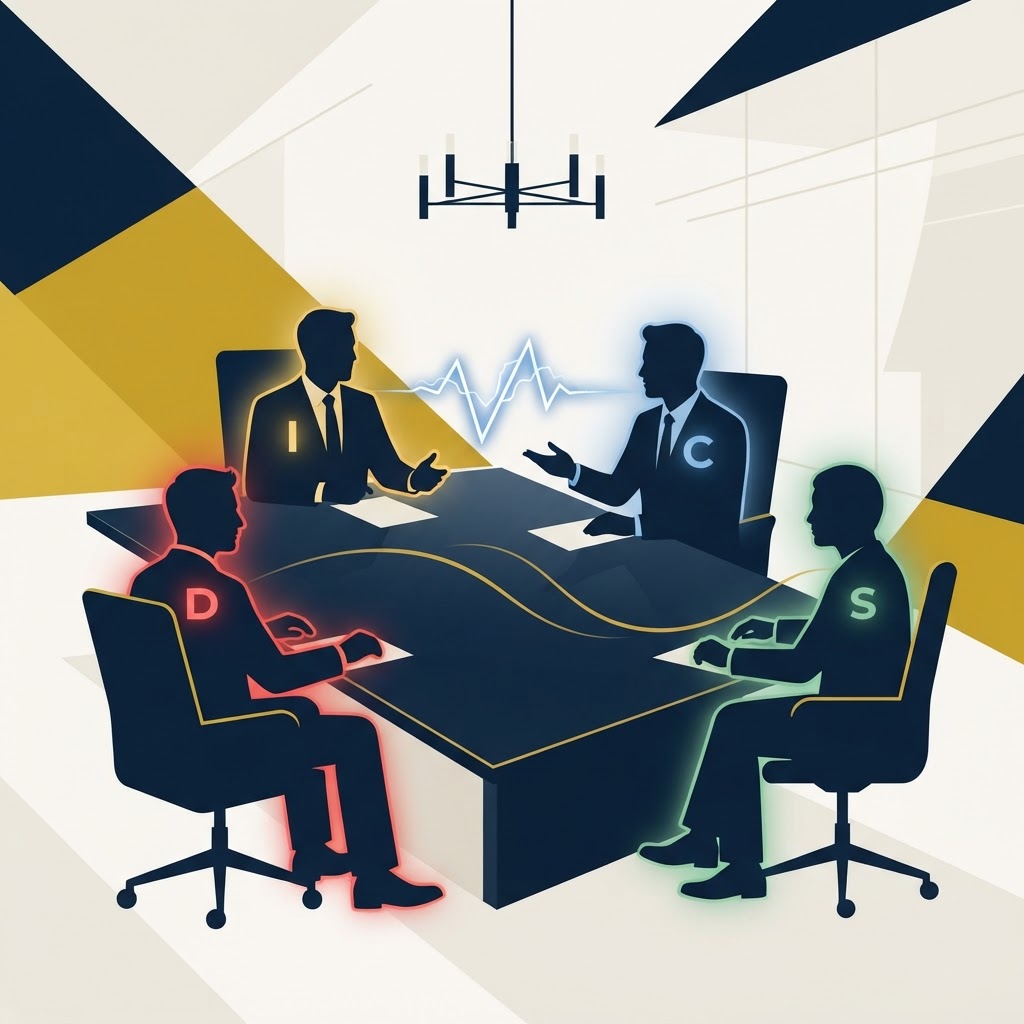
A board with five high-D personalities becomes a battlefield. A board with five high-S personalities becomes a support group. Neither solves business problems. DISC profiling is not a personality test. It is a behavioral map that explains why your management team fights about the wrong things and how to fix it.
Most management teams don’t fail because of bad strategy. They fail because the people implementing the strategy communicate past each other. The VP Sales sends a three-line email. The CFO sends a three-page email. Both think the other is being difficult. Neither is. They just have different DISC profiles, and nobody has named the difference.
What DISC Actually Measures
DISC maps four behavioral dimensions that shape how people communicate, decide, and handle conflict:
| Type | Drives | Communicates | Avoids |
|---|---|---|---|
| D — Dominance | Results, control, challenge | Direct, brief, fast | Small talk, process detail |
| I — Influence | People, recognition, energy | Stories, enthusiasm, expressive | Cold data, isolation |
| S — Steadiness | Stability, process, harmony | Patient, structured, gradual | Sudden shifts, pressure |
| C — Conscientious | Accuracy, quality, analysis | Data-driven, thorough, precise | Rushing, vagueness |
When you know who is what, you stop interpreting behavior as personal. The D-type CFO is not being aggressive. The S-type COO is not being passive. They are running different operating systems.
The Four Conflict Patterns That Kill Alignment
D vs D: Volume Escalation
Two high-D managers in conflict raise their voices and push harder. Each sees the other as an obstacle. Resolution requires facts, not opinions. The facilitator’s script: “You both want the same outcome. Let’s look at the data together.”
D vs S: Push and Withdraw
The D-type pushes for a decision. The S-type goes silent. The D interprets silence as agreement. The S interprets the push as aggression. Resolution: slow down the D, draw out the S. Give the S time to prepare their position before the meeting.
I vs C: Speed vs Certainty
The I-type wants to move fast. The C-type wants more data. The I sees the C as blocking. The C sees the I as reckless. Resolution: set a deadline for data, then decide. “What’s the minimum data you need? Can we set a Friday deadline for that data and decide Monday?”
C vs C: Analysis Paralysis
Two C-types want more data. Neither wants to decide. They keep analyzing while competitors move. Resolution: force a decision with incomplete data. “You’ll never have 100% certainty. What decision can you make with 80% confidence?”
Team Composition: Why Balance Wins
DISC is not just about individual coaching. It determines team composition. In peer advisory boards and management teams, balance is structural, not aesthetic:
- D (2-3 members) — drive, decisions, challenge
- I (1-2 members) — energy, creativity, networking
- S (1-2 members) — stability, process, listening
- C (1-2 members) — analysis, quality, risk assessment
A board with five D-types becomes a battlefield where nobody listens. A board with five S-types becomes a support group where nobody decides. The composition rule is simple: if everyone agrees quickly, you are missing a perspective. If everyone fights constantly, you are missing a stabilizer.
STRATPRO Phase 1: Using DISC for Alignment
In STRATPRO Phase 1 (ALIGN), DISC is deployed as a management alignment tool, not just individual insight:
- Map the team — each member’s profile displayed visually so everyone sees the composition
- Identify communication gaps — D types send three-line emails, C types send three-page emails. Name the difference.
- Build a Communications Charter — agreed rules for how the team communicates across profiles
- Assign roles by strength — D leads execution, C leads quality, I leads business development, S leads operations
This is why strategic alignment comes before strategic planning. A misaligned team with the best plan will still fail at execution. DISC gives you the language to fix the alignment before you waste time on the plan.
The CEO Loneliness Connection
High-D CEOs often experience CEO loneliness precisely because their direct style breeds conflict rather than candor. When you are a D=96 (like Nir Makovsky’s own profile), you must consciously slow down when working with C or S types. The self-awareness is the difference between a team that executes and a team that resents you.
Frequently Asked Questions
Is DISC a personality test?
No. DISC is a behavioral profile that maps how people communicate, decide, and handle conflict. It does not measure intelligence, values, or capability. It measures operating style.
How does DISC help management alignment?
In STRATPRO Phase 1, DISC is used to map the team, identify communication gaps, build a Communications Charter, and assign roles by strength. The goal is not to change personalities but to create shared rules for how different styles work together.
What happens when a team has too many D types?
A board with five high-D members becomes competitive rather than collaborative. Decisions escalate into confrontations. The fix is adding S or C types who bring listening and analysis to balance the drive.
Can DISC predict management conflict?
DISC identifies behavioral patterns that produce predictable conflict dynamics. D vs S (push and withdraw), I vs C (speed vs certainty), and C vs C (analysis paralysis) are recurring patterns. Knowing them lets you resolve the conflict before it escalates.
How does DISC work with accountability systems like E&A?
In E&A sessions, DISC helps the facilitator adapt their approach: D types need brief, results-focused challenge. C types need data and analysis time. S types need patient, structured progression. I types need rapport before data.
Expert Insight — Nir Makovsky
“My own DISC profile is D=96. I am a Persuading Conductor. When I coach a C-type manager, I have to consciously slow down, give them data, and allow analysis time. The C-type needs to feel the decision is well-founded, not just because I said so. The most expensive mistake high-D leaders make is assuming everyone processes information the way they do.”
Nir Makovsky, Founder of NIRMAKO, TAB Master Facilitator Israel. Business coach and strategic advisor for CEOs and business owners. Certified DISC practitioner, STRATPRO facilitator, and HI-MAP manager development specialist.