
The Business Diagnostic: Finding the Problem You’re Not Looking For
18 September 2026
Management Alignment: Why Your Best Strategy Is Already Dead
20 September 2026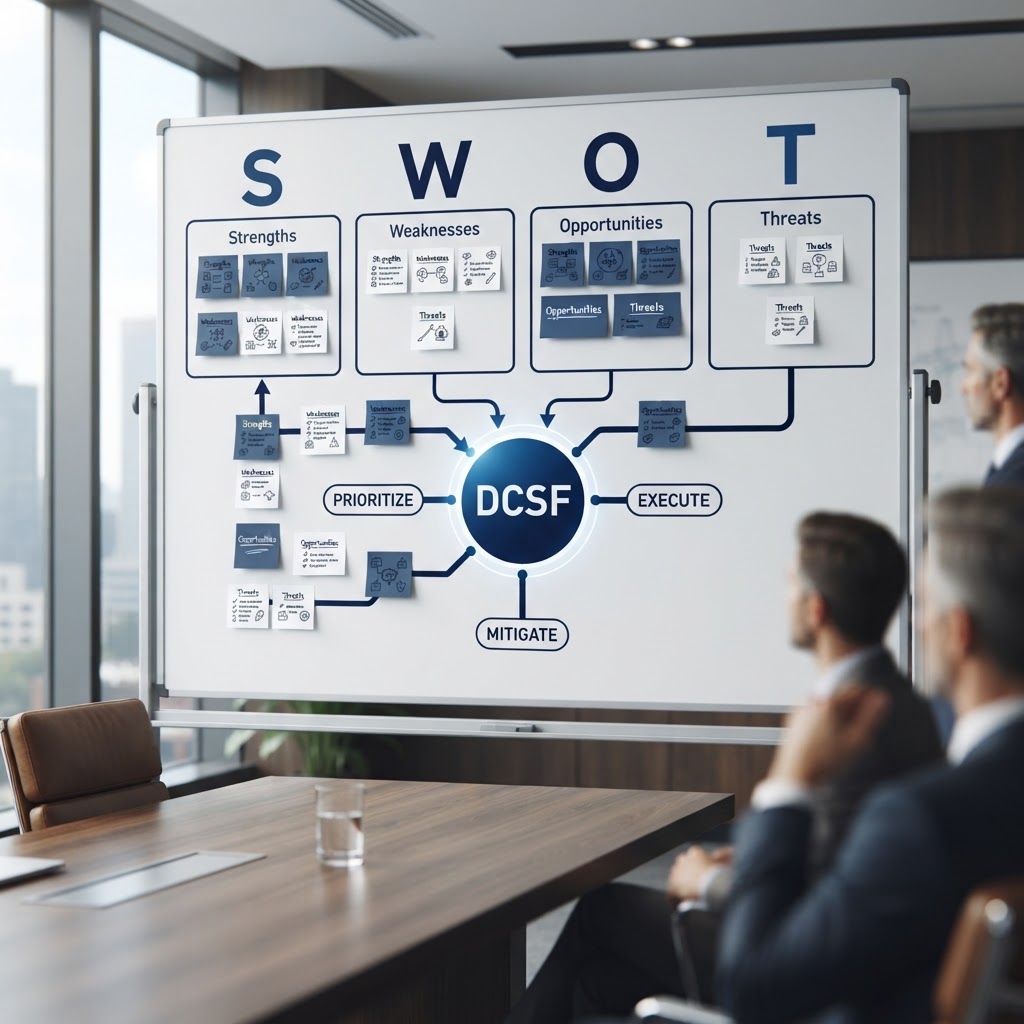
You did a SWOT analysis. Four quadrants, flipchart paper, every manager contributed. The facilitator typed it up. It looked professional. Then it went into a folder, and nobody opened it again.
Every executive has been through this. The SWOT is the most run strategy exercise in business, and it is also the one that produces the least action. Not because the framework is wrong, but because the way most companies run it turns a diagnostic tool into a brainstorming exercise.
Jack Welch said it plainly: face reality as it is, not as it was or as you wish it were. A SWOT that does not force that confrontation has no value. Here is how to run one that does.
Why Most SWOT Sessions Fail
Three things go wrong, and they go wrong every time:
| Failure Mode | What It Looks Like | Why It Happens |
|---|---|---|
| The Praise Cascade | Strengths fill the whole quadrant. Weaknesses get two polite items. Threats are “industry-wide,” not ours. | Nobody wants to name the uncomfortable truth in front of peers |
| The List Without Weight | 20 strengths, 15 weaknesses, 12 opportunities, 8 threats. Everything is equal. Nothing is prioritized. | No mechanism to rank or connect items to strategy |
| The Dead Document | Beautiful PowerPoint. No owner. No next step. Filed and forgotten. | The SWOT ends at the wall, not at a decision |
The Fix: Connect SWOT to a Single Critical Success Factor
In the STRATPRO methodology, SWOT is not a standalone exercise. It is one of three diagnostic tools in Stage 3 (DIAGNOSE), alongside the Business MRI and risk assessment. Its job is to feed one output: the Driving Critical Success Factor (DCSF), the single factor most critical to achieving your strategic vision.
The DCSF is the pivot. Everything in your plan, goals, strategies, action plans, tactics, traces back to it. A SWOT that does not help identify the DCSF is decoration.
How to Run a SWOT That Actually Drives Decisions
Here is the process, step by step:
Step 1: Run the MRI First
Before SWOT, run a Business MRI, a six-dimension diagnostic (marketing, sales, operations, finance, HR, technology) completed independently by each member of the management team. The MRI surfaces perception gaps. When the CEO scores sales an 8 and the VP of Sales scores it a 4, you have found the real weakness before anyone writes it on a sticky note. Read more about how to identify your critical success factors.
Step 2: Confront Weaknesses Honestly
Ask each manager to name two weaknesses they believe the CEO is underestimating. Collect them anonymously before the session. In the room, read them aloud. Do not debate who said what. Discuss whether the weakness is real. This single move breaks the praise cascade.
Step 3: Cross-Reference, Do Not List
Do not leave the items in four separate quadrants. Cross-reference them: which strengths address which threats? Which opportunities expose which weaknesses? This produces a strategy matrix, not a list. Each cell in the matrix is a potential strategic move.
Step 4: Distill to the DCSF
From the matrix, identify the five Critical Success Factors, the factors without which the vision cannot be achieved. Then distill those five to one: the DCSF. This is the factor that drives everything else. Every goal in your 90-day sprint connects back to it.
Step 5: Assign Ownership Before You Leave the Room
Each item in the strategy matrix gets one owner. Not a department. A person. If nobody volunteers to own a weakness, it stays on the wall indefinitely. The session ends only when every item has a name next to it. This is the same principle behind E&A accountability sessions: no owner means no action.
What Happens After the Session
The SWOT does not live in a folder. It lives in the next planning cycle. The DCSF becomes the filter for every strategic decision: does this initiative move the DCSF? If not, it goes on the backlog, not the sprint.
Without strategic alignment in the management team first, the SWOT session will revert to the praise cascade. Alignment is the prerequisite. A team that cannot speak honestly cannot diagnose honestly.
The Bottom Line
A SWOT analysis is a diagnostic tool, not a brainstorming exercise. Its purpose is to force the management team to confront reality and identify the one factor that determines whether the strategy succeeds. If your last SWOT did not change a single decision, it was not a SWOT. It was a list.
Expert Insight from Nir Makovsky
The most common finding in a properly run SWOT is not a surprise threat. It is a weakness the management team already knew but had never said out loud together. The value of the exercise is not discovery. It is acknowledgment. Once the team names the weakness collectively, the strategy changes. That is the moment the SWOT becomes worth the time it took.
Nir Makovsky is a business coach, strategic advisor, and TAB Master Facilitator in Israel. He works with management teams of established companies on strategic planning and execution through the STRATPRO methodology.
Frequently Asked Questions
How often should a company run a SWOT analysis?
As part of the STRATPRO cycle, SWOT runs annually during the DIAGNOSE stage. However, if the market shifts significantly, a focused SWOT on one dimension (such as threats from a new competitor) can be triggered mid-cycle without repeating the full diagnostic.
What is the difference between SWOT and a Business MRI?
A Business MRI is a quantitative six-dimension assessment completed independently by each manager. SWOT is a qualitative strategic analysis. The MRI surfaces perception gaps between managers; the SWOT converts those gaps into strategic priorities. They work together in the DIAGNOSE stage.
What is a DCSF and why does it matter?
The Driving Critical Success Factor (DCSF) is the single most critical factor for achieving your strategic vision. It is distilled from the SWOT and MRI analysis. Every goal, strategy, and tactic in the plan traces back to it. Without a DCSF, a strategic plan is a list of priorities with no hierarchy.
Can SWOT work without management team alignment?
No. Without alignment, managers protect their departments rather than confronting shared weaknesses. The SWOT becomes a diplomatic exercise rather than a diagnostic. Strategic alignment, through DISC assessment and a communications charter, is the prerequisite for an honest SWOT.
Ready to Run a SWOT That Actually Drives Decisions?
A peer advisory board gives you the honest external perspective your management team needs. Join a Taste of TAB session and see how other owners confront their weaknesses.